From the Meekatharra Miner, Saturday 22 September 1917. .
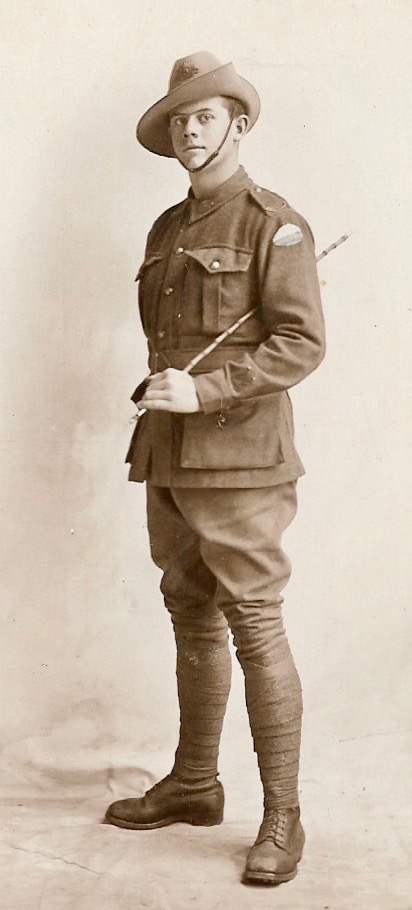
‘Extract from letter received by Mrs. J. E. Coombes from her son, Private Russell Wheeler, No. 413, 44th Battalion.’ (Of course, the letter home doesn’t tell the full horror of the trenches)
‘I take this opportunity to tell you about the “Big Push.” that I have just come through safely, thank God. I am not allowed to mention places, but you will know the advance I am referring to. I can say it was in Belgium, and the whole ridge is named after the town. Although the Australian boys had a large part to play they were hardly mentioned in the papers, and it was the New Zealanders, and not the Irish, who took the town. My Battalion was in a huge dugout when the big mines were blown up. Just at daybreak we were awakened by a terrific explosion, closely followed by two more just as severe. Then our guns, which had been fairly quiet for a time, opened up like a thousand peals of thunder rolled into one. This kept up for several hours, and our hearts were gladdened by good reports of success. We were kept in our super-dugout all that day and till midnight, when we were called upon to go out and capture a certain portion of ground for the new front line. We had to go through the land that had been occupied by the Huns some twenty-four hours previously, and you would have to see that land to realise what a hell our barrage must have made it for ”Fritz.” For about a mile and a half the ground was a barren desert full of shell-holes from three to eighteen feet in depth, and so close together that the edges were touching. This is supposed to be the greatest artillery battle the world has ever seen, and I can quite believe it, as I fail to find words to describe how the British guns devastate everything before them. We were the right pivot of the advance, and our left was a few hundred yards south-east of the town, or rather the heap of broken bricks that had once been the town. Eventually we reached the new front line, and our boys went on and captured another fair slice of Fritz’s land ; but about mid-day old “Fritz” began to put a H.E. barrage on us. This lasted ten hours, and I am still wondering how we came out of it so well. One would think that nothing could have lived through it. Another chap and I lay down in a shell-hole, and slept through part of it ; we were thoroughly exhausted. All this shelling, however, was of no use. He could not move our line an inch.
Next night he tried his luck with gas shells, with no better results.. Between the new front line and the support line the enemy lay dead in heaps, evidently having been caught in our awful artillery barrage. Nothing on earth could stand it for long. Fritz surrendered in hundreds and seemed pleased to be out of it. They seem to be absolutely demoralised, and never seemed to put up much of a fight with our infantry. I had occasion to take messages to the front line through a couple of fierce barrages of H.E. and machine gun fire, and although in full view of Fritz’s line, I never sustained as much as a scratch, for which I thank God. At present we are out for a spell — some miles behind the line — and but for the occasional growl of the guns there might be no war on at all…’
A few weeks later, Russ Wheeler was severely wounded at Passchendale. Fortunately, he survived and came home but suffered all his life from the effects of that serious wound.
He was my dad.
 Lynne Cairns