Today, Australia ranks second only to China as a gold-producing country. And much of that gold still comes from Western Australia, which was still an isolated British colony, less than sixty years old, when the first gold finds were recorded.
In the middle of the nineteenth century, when poverty drove many from their homelands to wander to the far corners of the Earth, suddenly the dream seemed to be within their grasp. In mid-century, gold was discovered in America’s west. Local workers walked off their jobs and sailors deserted their ships. When word got out, men from all over the world headed for California.
Those from Australia might as well have stayed home. In 1851, the Australian gold rush began with rich finds at Bathurst in NSW and Ballarat and Bendigo in Victoria. Scenes like those in California followed. Work stopped as men abandoned their jobs and headed for the fields, often leaving wives and children with no support. Again, ships were deserted in the harbours.
By 1860, Australia’s population increased by over 207 percent and eastern Australia boomed, especially Victoria and its capital, ‘Marvellous’ Melbourne. As the easy gold ran out some were tempted to head for South Africa’s rich Transvaal finds, or WA’s new Pilbara and Murchison finds, but most were happy to stay put and enjoy the good times.
Then, in 1891, came the inevitable bust. Banks closed, businesses failed and unemployment soared. Men walked the street in ragged clothes or headed bush on the Wallaby Track, to live off the land and do odd jobs for meals on struggling outback properties.
Then, in June 1892, in Western Australia’s dry interior, Bayley and Ford struck gold at the place that was to become Coolgardie, collecting two thousand pounds worth in one evening. Within weeks, another three thousand ounces of alluvial gold were found. And the rush was on. with men from all over the world converging on the isolated colony and its even more isolated interior. Newchums from Britain and the Australian cities joined tough old veterans of the Victorian and Californian gold rushes, to answer the allure of gold.
Coolgardie was soon overrun with men from far and wide. Within a few months, a town was established , albeit an ephemeral one made from canvas and hessian.
Then in June 1893, Paddy Hannan and his mates arrived in Coolgardie, having picked up off the ground some seventy ounces of alluvial gold. As the papers reported ‘A perfect stampede’ began. By the next morning Coolgardie was practically deserted and it was estimated that 400 men would arrive at the new rush, already being called Hannan’s Rush, during the day.

Rain had been falling continuously for the past twenty-four hours and it was reported that water was plentiful within eight miles of the new find. That situation wasn’t to last long. The eastern goldfields is not a place of wet winters, and by summer, the situation was dire. Extreme heat and water shortage made life unbearable and an exemption was granted during the hot summer months to allow men to leave their claims without forfeiting them, so they could head for the cooler coast.
As it was 1896 before the railway line from the capital, Perth reached Coolgardie and Kalgoorlie, it was no easy journey from the ports of Albany and Fremantle. Some could afford to buy horses or rides on wagons, but many walked, carrying their worldly goods or pushing wheelbarrows, often knocked together from bush timber.
Today, seeing the barren plains, dotted with ghost towns, that surround Kalgoorlie, one would suppose that anyone who set out on foot with no air-conditioned, four-wheel-drive vehicle, no refrigeration and only the water he could carry, must have been insane.
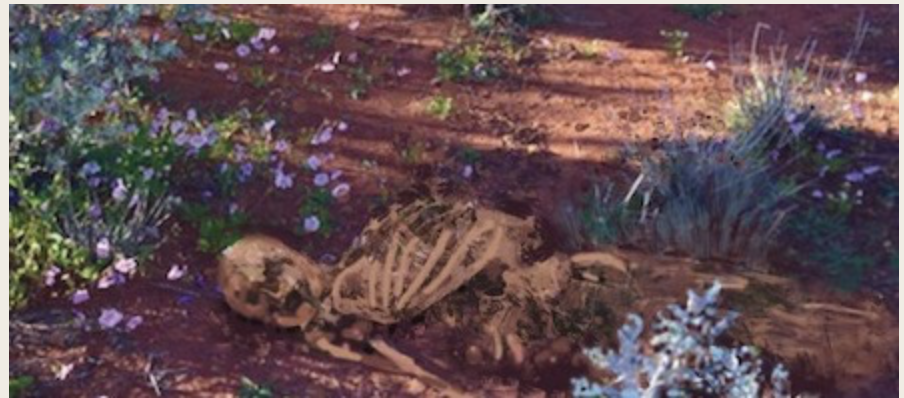
Most of these men were completely rational, however. But, unlike previous gold rushes, water was even scarcer out there than gold. Even veterans sometimes underestimated the semi-desert conditions. So, from time to time, prospectors would come upon the decaying remains of men who had perished of thirst. But these gruesome finds deterred few of those afflicted by gold fever.
With so many diggers streaming into the new goldfields, it was hard to keep track of them all, and government agencies were soon stretched to the limit. At Hannans, still little more than a camp, with canvas or hessian-covered buildings straggling along either side of the road to Coolgardie, even the Post Office and Police Station were just tents.
Very soon, the police were being asked to trace missing men, but the places prospectors were heading were yet to be found on any map. I remember finding, in a Post Office Directory of the time, an address listed as ‘Harder to Find’. I assume it was a humorous name for a gold find, but perhaps it was simply the truth. At best it would have been like trying to find a needle in a haystack, and there were some who didn’t want to be found. A late nineteenth century gold rush, with no phones, no electronic media, few newspapers and very slow travel, was a perfect place to hide from your wife, your creditors, or from the police themselves.
Meanwhile, the postal service could barely cope with all the letters and parcels, often simply addressed ‘care of the Post Office, Hannans’. But Hannans or Hannan’s Find, as Kalgoorlie was called at first, was at the centre of a wide area dotted with isolated gold finds, some of which were later to become bustling towns. Food supplies were also to be a problem. In June ’93 flour and oatmeal were selling at Coolgardie for a shilling per pound and a ‘ tucker ‘famine was said to be imminent.
It was to be another nine years before, thanks to the genius of C Y O’Connor, water was brought the 530 kilometres from Mundaring Weir in the hills near the capital, Perth. Even in the winter, when the creeks ran, clean water was in short supply because the diggers muddied the creeks, so cleanliness was difficult. Sewage was not disposed of in a sanitary fashion, and disease was common. There were a few doctors or chemists at the diggings, but not all were qualified. Many people died of diseases such as dysentery or typhoid.
This was a time long before power tools. Work was done with a pick and shovel, so prospecting and mining was hard, dirty work and, with no water to wash clothes, the men could only try to beat the red dust out of them. Most took Sunday off and tried to tidy up a bit, trimming beards, washing faces and hands and shaving in tiny amounts of water.

Until the railway finally reached Coolgardie and Kalgoorlie in 1896, everything, food, building materials, and – after the big mines got going, heavy mining equipment – had to be transported hundreds of kilometres into the dry interior from Fremantle (600 km away), Albany or Esperance by camel or donkey trains, or wagons pulled by horses. The extra width of Coolgardie’s Bayley Street echoes the problems of turning camel trains.
Integral to the economic development that occurred during this period was the appointment of C.Y. O’Connor as engineer-in-chief for a large government capital works programme. In this period of rapid economic growth, unprecedented levels of public infrastructure expenditure (which was previously restricted through lack of revenue) took place. The Goldfields Water Supply scheme (via a pipeline from Mundaring Weir to Kalgoorlie) is perhaps the best known, but the development of the Port of Fremantle opened up the State’s export capacity.
The development of railways during the era of the goldrush was also important, with the extension of the line to Kalgoorlie in 1896, making the Goldfields more accessible. Demand for railway line sleepers provided a significant boost to the local timber industry. Nevertheless, while exports of other commodities (such as wool and timber) increased over the period, the economy was still predominantly driven by gold, which comprised 61% of total exports in 1901.
 Lynne Cairns